Tales of Small Texas Towns
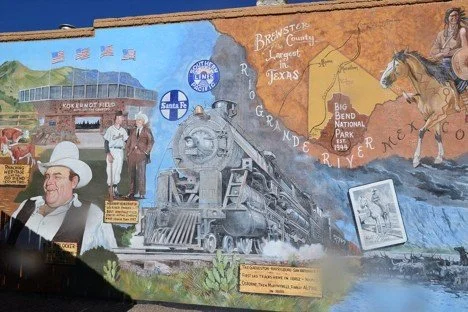
A mural in Alpine, Texas. Many small towns have great murals.
Four stories about towns in West Texas
Alpine Texas is a small desert mountain town that got “small town” right
Alpine, Texas is not in my top 10 favorite places to visit, but this small West Texas town has a lot going for it. It is in a very remote area, but in some ways, it is a cool place.
Alpine was named for its mountainous surroundings, but that seems like a stretch in this barren desert area. It is mountainous for sure, but there are no alpine trees, and probably very little if any, snow. It still beats the original name of Murphyville.
One thing about remote small towns is that you have to create your own entertainment. Often I find them more interesting than larger cities because people had to be creative to make them livable. Some have done better than others, and I think Alpine deserves all the accolades it gets.
It’s about 80 miles north of Big Bend National Park. The town itself is about 5,000 people. It’s very remote. It’s 500 miles to Dallas or Albuquerque, and 400 from Austin.
It has a plethora of murals, which are well done. They are entertaining as well as informative about the history and sociology of the area. A lot of small towns have murals, but Alpine has more than most.
It has an old vinyl record store. There are some very old and valuable albums there, but they know what they have and are not selling them cheaply.
It has some nice restaurants and decent hotels. There is live music and they take their Texas music heritage seriously.
Alpine was a stop along the trail for cattle drives in the 1860s. A little later it was a town for the railroad that was making its way south, which would end the cattle drives as fast as they started.
A description in 1888 said the town had about a dozen houses, three saloons, a hotel and rooming house, a livery stable, a butcher shop, a drugstore, and a post office.
Unlike a lot of small towns, Alpine is not shrinking. In 1920 it had 1,000 people, and that rise to almost 2,000 in 1930. By 1950 it reached 5,200 and is at about 6,000 today.
It still has a lot of old buildings that are more than 100 years old.
There is a walking tour of the downtown, with historic buildings all around. There are a lot of art galleries, bookstores, record stores, and restaurants — all the cool things you want to see in a small town.
You can stay at hotels and eat at restaurants that are 100 years old.
There is a great museum of the area’s history on the Sul Ross University campus.
Kokernot Field is a famous baseball stadium built in 1947 for a semi-pro baseball team that still lives. Sports Illustrated called it the “Best Little Ballpark in Texas.”
There are also a couple of driving tours that will take you through some of the most scenic areas you will find anywhere. One makes a circular trip to Big Bend and does not backtrack. Another goes from Alpine to Marfa, to Fort Davis, and back to Alpine.
Kermit, Texas died and came back to life
The desert of West Texas is bleak. The mountains are to the south, and it's flat as far as the eye can see, and the scenery does not change. It is brown most of the year, and the sky is clear — no clouds and no rain expected.
Settlers made a go of it in the late 1800s, and it was a tough existence. Small towns did spring up as the railroad made its way west, or as the army put up forts and so forth. A year or two of drought could send the settlers flying away in defeat.
Some towns survived, and some did not. There are a few that went to the brink of death but made a comeback. One such town was Kermit, which was all but gone when the oil boom brought it back.
Kermit was the county seat when the county was organized in 1910. Before that, it was a wasteland, but there were a few people around. Kermit was started as a center for area ranches.
It is about 10 miles from the lower edge of New Mexico, and about 100 miles from Big Bend National Park and the Mexican border.
The town was named after one of Teddy Roosevelt’s sons. It was the original county seat. In 1916 a drought chased most people away, and it declined from there. In 1924 there was only one family left, and only one student attending the local school.
Oil was discovered on July 16, 1926, and the town got a new life thanks to the oil boom. By 1927 it had 1,000 people, and by 1929 it was up to 1500. It was incorporated in 1938 and continued to grow. It got its first bank and the first hospital in 1946.
The oil boom lasted through the depression, and the town kept growing. By 1960 it had 11,000 people. It has declined since then as most small rural towns have, but it still has around 6,000 and is a decent enough small town.
The town is not a tourist attraction by any stretch, but it is a nice enough little town. There are hotels and some nice restaurants.
It’s seven miles from Wink, Tx., the birthplace of Roy Orbison. Wink has about 1000 people today, and followed the same pattern as Kermit. No doubt Orbison played music in Kermit at some point.
One small Texas town stayed tame in the Wild West
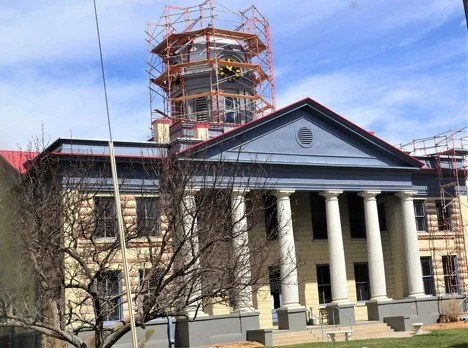
I like to see historic buildings taken care of, but it is still aggravating to come across a small town with a courthouse under repair. I have a lot of pictures of courthouses and quite a few with scaffolding like this.
Fort Davis, Texas, is a very small town in a remote area of west Texas. It has roughly 1,000 people, and it has been at about that size for several decades. It’s not even an incorporated city, which makes a nice courthouse like this somewhat of a surprise.
The town is the highest point in Texas, at nearly 5,000 feet above sea level. It was started because a fort sprang up there during the Indian Wars of the 1850s, called Fort Davis. It was named after Jefferson Davis, who would become the president of the Confederacy.
It was strategically located at the intersection of two major trails settlers were using to go west. Today it is at the intersection of state highways 17 and 118. It’s about 100 miles from the Mexican border, and the closest towns are places like Marfa or Alpine, also small towns in the middle of nowhere.
The nearby Fort Davis is the most well-preserved military installation of the mid-1800s. Forts were set up at strategic locations to defend settlers and mail delivery, against Indians.
With its higher elevation, it is not as hot as some areas of Texas and has been a resort-type place for the wealthy at various times. For whatever reason, the town has never grown into much of a tourist area. It has avoided deteriorating as many small towns have over the years. This very small town was almost pristine in appearance.
Unlike a lot of old west towns, its reputation is fairly pristine as well. Usually, when a town sprang up, it was for mining, the railroads, or for a new fort in the area. Gamblers, bar owners, and prostitutes were usually soon to follow.
There was probably some of that in Fort Davis, but I could not find many tales of wildness. Maybe that is because it did not come into existence because of the fort. There was a small town here already when the fort was created, and it had been there a long time. It was also the site of an old Indian settlement.
The area is a high desert, so there are a lot of rocks and sand and about everything is brown or grey. The scenery is still spectacular with all the rock formations and varied landscapes. There is a 75-mile loop you can drive around the mountains of the area, which is well worth the two or three-hour long trip.
Fort Davis was an interesting stop on the way from Big Bend National Park, back home to Kansas. We still had a long way to go, but there was no rush. It is probably not a place I will go back to, but hiking in this area would be very cool. There are a lot of trails in the area, and you can trace some of the ancient trails Indians, as well as settlers, used.
A note about the history
It is impossible to explore this area without a lot of information about the Indian wars and the Civil War.
It was a different time and a different world than what we live in today. Hopefully, we are more civilized now. That can be debated.
It was the heart of both the Confederacy and where land was stolen from the Indians. I am not sure how much slavery was practised in this area. There were not all that many settlers here, and most were passing through on their way to California. Still, the area supported the Confederacy. The fort, the town, and the county were named after the president of the Confederacy — Jefferson Davis.
I don’t think it is wise to cover up, destroy, or ignore history. It is our history, with both the good and bad parts.
Shafter, Texas went down the Shaft
There’s something mystical and appealing about remote places. They seem remote to us as we speed down a highway at 70 MPH, but just imagine how it felt going not even 5 MPH in a wagon or on horseback 150 years ago. It would take days, if not weeks, to get to civilization that we get to today in an hour.
I wonder what possessed people to want to come to these rugged, remote places. My friend wonders what possesses me to go to those places today. They had to contend with hostile Indians whose land they were trespassing on, as well as snakes, a lack of water, cold, heat, and many other natural dangers.
They were chasing fortunes and some were just chasing a job that would provide food, clothing, and shelter.
The miners who worked in this town were Mexicans, as well as a lot of African Americans. These harsh conditions brought together people of different races and cultures, and they lived together well.
Being very remote is comforting in a strange way. The silence can be suffocating but that too has an appeal. Still, I think I would not find it as interesting if I lived here full-time with no modern conveniences.
Shafter, Texas is one of these places. It was once a silver mining boom town but is a ghost town now. It had 11 people in the 2,000 census, and probably fewer in 2020.
At one time it had 4,000 people and several businesses. Like a lot of boom towns, when the silver dried up the town did too.
Shafter is a ghost town about 25 miles from the Mexican border on Highway 67. It’s about 40 miles south of Marfa.
Shafter was started in the late 1800s when some people discovered silver. They got the commander of Fort Davis, about 25 miles away, involved and a town was slowly built. The town took the name of the Fort Davis commander. They didn’t know how to mine silver and didn’t have the equipment, so it took a few years for the mine and the town to get rolling.
The town was started in 1880. It was not until 1882 that a mining operation was established. It was a typical company town, with the company providing housing for the workers, as well as pay. There are lots of horror stories about company towns, but there are some positive ones as well.
It was quite a task getting mining equipment to this area in the late 1800s. It was probably at least 100 miles from the nearest railroad. There were no roads, so they had to make roads to transport the equipment.
The town grew steadily and by 1940 had 4.000 people. Silver prices crashed and the silver itself ran out. By 1943 the population was down to 1500, and by 1949 it had 20 people.
There have been a few attempts to reopen the mine, but none have succeeded. The town has grown to 100 people a time or two since 1949 but is back to that level now.
The only building still standing is the church. There were some small houses in the area, but none at the original townsite.
