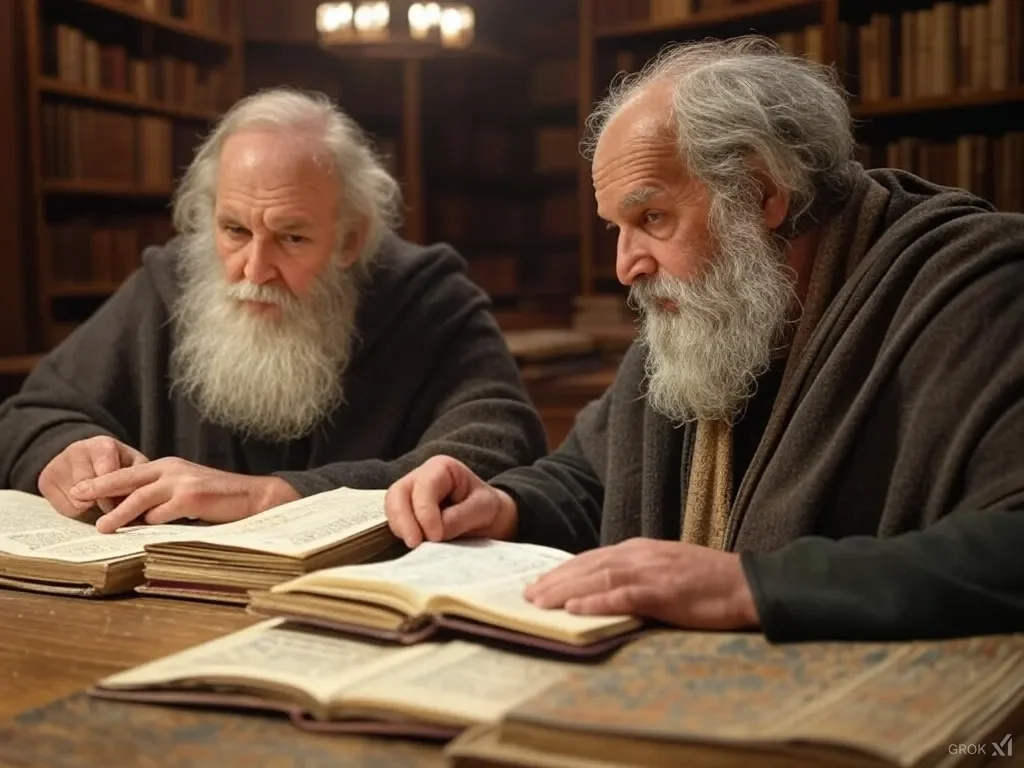
A Case for Serious Bible Study: Spiritual Growth

Photo from Unsplash
"Do your best to present yourself to God as one approved, a workman who does not need to be ashamed and who correctly handles the word of truth." — 2 Timothy 2:15
We hear preachers and would-be prophets delivering all kinds of messages, and it isn't always easy to know what's true and what isn't. But what we can know for certain about God — objectively, verifiably — is written in the Bible. That's why Scripture, and the serious study of it, matters so much. The best way to build a real relationship with God is to study Him in the pages He gave us.
What "Study" Actually Means
The King James Version renders 2 Timothy 2:15 as "study to shew thyself approved." The NIV translates it "make every effort." Both come from the Greek word spoudazo — to put in effort, to work hard, to be diligent.
Notice what it doesn't mean. It isn't passive reading. It isn't waiting for a feeling or a sudden flash of insight. It means doing your best to understand the meaning — actively, deliberately, on purpose. Do that, Paul says, and you'll be able to "correctly handle the word of truth," a phrase pointing to the message of the Bible itself.
Paul is telling Timothy — and every Christian after him — to work at becoming the kind of believer God approves of: one who can handle Scripture accurately. Get that right, and two things follow. You grow closer to God. And you become harder to fool.
There are plenty of preachers out there teaching things that simply aren't true, twisting Scripture to fit an agenda. If you don't know what the Bible actually says, you have no way of knowing when someone is misleading you. That alone is reason enough to study consistently.
Study Means Digging, Not Skimming
Real study means digging in, meditating, praying over the text — not reading passively. It means picking a passage apart and asking every question you can think of. You won't always find the answer right away. But the only question guaranteed to go unanswered is the one you never ask.
It helps to be clear about what you're studying. At its core, the Bible is God's love letter to you — His way of revealing Himself. It has supernatural origins, but for the most part it reads quite naturally, and we're meant to bring our whole minds to it, using every tool available to get the most out of our time in it.
It's worth saying plainly what the Bible is not. It isn't a rulebook. It isn't a history book. It isn't even primarily a how-to guide for life — though it contains elements of all three. First and foremost, it's a love letter from God to us. And because it's addressed to us personally, it's worth digging out the meaning ourselves, even while we listen to good teachers and preachers along the way.
Not About Earning Approval
It's worth pausing on Paul's phrase "to show yourself approved," because it's easy to misread. God's approval of us isn't conditional on nailing every fine point of interpretation. God approves of us because we believe in His Son. There is nothing we do to earn salvation — that's simply not what this passage is about.
What Paul is saying is that we should be able to present ourselves as workers who handle the word rightly — the kind of Christian who doesn't fall into error or lead others into it. It's the believer, not God, who bears the consequences of handling truth carelessly.
Paul's word picture is a workman who has no reason to feel ashamed of his work. Think about how you'd feel if your boss walked in and your work was sloppy — versus how you'd feel if it was done well. It's the same with Bible study. Handle the word accurately, and you avoid being misled, which is exactly what pleases God.
And to be clear: God doesn't need us to study in order to accomplish His purposes. We are the ones who benefit. The whole point of Bible study is to know God better and deepen the relationship He's already given us — not to check a box for Him.
Three Pictures of Effort
Paul isn't content to make his point once. In verses 3–6, he offers three word pictures — a soldier, an athlete, a farmer — each showing what it looks like to grow.
The soldier endures hardship with loyalty and focus, unwilling to be distracted from the mission. In the same way, we're called to stay focused on the word of truth.
The athlete only wins by competing according to the rules. Every sport has boundaries, and there are no shortcuts to victory. The same is true of spiritual growth — it takes going through the process, putting in the time.
The farmer works a field that ultimately belongs to someone else, and still gets his share of the crop. Seeds don't become fruit overnight; growth takes time. So it is with Scripture: our understanding won't arrive instantly, but the effort we put in will eventually produce a harvest.
The thread running through all three is simple — spiritual growth takes effort. None of this is about earning salvation. It's about becoming the kind of person who can handle the word accurately and, in doing so, knows the truth.
Using Your Mind, Not Just Your Feelings
Handling Scripture well means engaging your mind, not just your emotions. A lot of people interpret the Bible primarily through feeling, sometimes even attributing those feelings to the Spirit. Feelings have their place — but truth is something we come to know with the mind, and it's the mind that should ultimately govern how we live.
We also carry preconceived notions, often absorbed since childhood, that may or may not hold up under scrutiny. The goal is to approach the text honestly and objectively, looking at what the words actually say before drawing conclusions — and always reading in context. That's one reason it's worth reading through the whole Bible more than once: it gives you the full picture, so no single verse gets pulled out of its setting.
Questions Are Welcome
Handling the word accurately also means asking questions — even hard ones. A healthy skepticism toward teachings and beliefs (not toward God Himself) is part of careful study.
Consider "doubting Thomas," who refused to believe Jesus had risen until he saw for himself. Jesus didn't rebuke him for asking. He let Thomas see what he needed to see. That's the same posture God takes with our questions. We may not get a sign written in the sky, but if we search and study, we eventually find an answer.
The Passage in Context
It's worth stepping back and reading 2 Timothy 2:15 inside its chapter. Paul is writing to Timothy, a young pastor, though the encouragement applies to every believer. The theme of the chapter is spiritual growth — both helping others grow and tending to your own walk with God.
Paul opens by urging Timothy to "be strong in the grace that is in Christ Jesus" (v.1). We aren't strong on our own; it's a matter of faith, trusting that Christ is the source of our strength. From there Paul moves into the three analogies already discussed, before landing on verse 15's call to "rightly divide" the word of truth.
That phrase — "rightly divide" — comes from a Greek term a carpenter might use, meaning to cut something accurately, to correctly interpret it. Verses 11–13 function almost like a short poem on cause and effect: not salvation by works, but a simple principle that effort produces results. And even here, Paul softens it with grace — "if we are faithless, He remains faithful" (v.13). Even when we fail at handling the word well, God doesn't walk away.
Paul then warns against quarreling over words (v.14). Few things stir up emotion like religion, and people can get so attached to being right that arguments turn into open conflict. Paul isn't telling Timothy to agree with people who oppose him — just to avoid getting dragged into pointless disputes. Arguing rarely helps anyone. Working diligently to find the truth does.
The Reward of Diligence
When you actually put in the time, something interesting starts to happen. You'll be reading one day and something from last week's study suddenly clicks into place. A word study from days before resurfaces at just the right moment, and the pieces come together into a new understanding — one grounded in the facts of the text, not in a feeling that may or may not have been reliable.
That's the payoff Paul is pointing to. Like the soldier's loyalty, the athlete's discipline, and the farmer's patience, our reward comes from doing whatever the work requires. Handle the word rightly, and you'll be equipped to apply it to your life — and your relationship with God will grow because of it.
Who is Right: Calvinists or Armenians
Calvinism emphasizes the role of God, while Armenians emphasize man’s role. Choosing one might reveal more about your priorities than God’s truth.
Theology is not something you find, put in a box, and then you are done. Your theology should be a part of you. It should develop as you continue on your spiritual journey.
Some people don’t like paradoxes, and I suppose I’m the odd one. I like the grey, the lack of certainty, embracing the mystery. The paradox between free will and God’s sovereignty is just one of those things that I cannot explain. Again, choosing one might reveal more about your priorities than God’s truth. I am OK with that.
Image created by AI
What you choose may say more about you than anything.
The two main theological systems of protestant Christianity have clashed for years, and we seem no closer to solving the issue now than 500 years ago.
The point of either one is to put the entirety of the gospel into perspective. They both try to make something very complex into something easy to understand, which has some value. Both have strengths and weaknesses.
Both try to explain the greatest mysteries of life.
What is the nature of God?
What is the nature of man?
What is the nature of the relationship between God and man?
Trying to break that into five short points is an oversimplification, to say the least.
I can see how both are justified Biblically. I could make a decent Biblical case for either one, or build a Biblical case to refute either one.
The problem, as I see it, is either one has to explain away some of the Bible. The same scripture that says “whoever will,” also says “God chose you.” The interesting thing to me is that Biblical writers recognized this and did not see a problem with saying both.
It is we who have a problem. Instead of letting the Bible say both, and believing that both are true — because that is what the Bible says — we try to make only one of them true.
This is why Calvinism and Arminianism exist, and why the debate rages. Both have good qualities but both have to ignore verses they don’t like.
There are “tensions” in the Bible, ideas that appear to oppose each other. They are a paradox. Some people don’t like paradoxes because it leaves uncertainty.
That is basically what Calvinism and Arminiasm do. God chose us, yet God says whosoever will. The options are to believe both are true because that is what God said-or pay more attention to one or the other.
My background
For some background: I was once pretty much a Calvinist. I didn’t believe in limited atonement because it is clear that Jesus died for the sins of the entire world. I would say that it is effective only for the believer. But if that is the case, why is it even necessary for people to accept the gift when it is already paid for and given?
I also struggled with irresistible grace. I was pretty good at resisting grace — regeneration — even as a believer, so it was hard to believe one could not refuse to be part of God’s family.
A lot of Christians mix and match, liking two or three of one or the other. That may be a good way to approach the two, or you can see both as having value, but see no need to align with one or the other.
The mystery
God is all-knowing, all-powerful, sovereign over everything that exists, or ever will exist. Logically, this means God knows the future, which causes one to struggle with free will. But somehow, in a way I cannot explain, God knowing the future is not the same thing as God ordaining or planning the future.
We still have choices even though God knows what those choices will be. If God is all-knowing and all-powerful, he has to know the future. Some Christians think God is at the same time we are and does not know the future, but that seems to go against the sovereign nature of an all-powerful God.
Calvinists paint God as an arbitrary ruler who orders the outcome, which is not fair. Armenians weaken God to make Him dependent on our choices.
Or to put it more positively.
Calvinists see God as all-knowing and all-powerful and develop the rest from there. Armenians focus on the human aspect of the relationship with God.
Does it matter?
The thing is, there is no reason to choose one or the other. Adopting either one can be an excuse not to think for yourself or to wrestle with deep theological questions yourself. It’s much easier to grab a list of points and then defend those points. You can find plenty of Bible to back up either one of those theological constructs. But you end up having to explain away other parts of the Bible.
The basic message of the Bible is simple, but trying to understand God is difficult. Our finite human minds can’t gasp the mind of God.
A better way
Instead of debating this issue, choosing one or the other, and defending that viewpoint, we should develop our theological system ourselves. It will take a very long time and a lot of work, and you may never complete the work, but that would be more fulfilling.
Calvinism emphasizes the role of God, while Armenians emphasize man’s role. Choosing one might reveal more about your priorities than God’s truth.
Theology is not something you find, put in a box, and then you are done. Your theology should be a part of you. It should develop as you continue on your spiritual journey.
Some people don’t like paradoxes, and I suppose I’m the odd one. I like the grey, the lack of certainty, embracing the mystery. The paradox between free will and God’s sovereignty is just one of those things that I cannot explain. Again, choosing one might reveal more about your priorities than God’s truth. I am OK with that.
When “Prayer and Fasting” was banned from the Bible
Some critics of modern Bible versions point out where verses in the King James Version are “left out” or listed only as footnotes in more recent translations.
The story of a man who was a “lunatic” who was healed by Jesus is told in the three synoptic gospels. The disciples had been given power and authority to drive out demons but in this case, they had failed. Mark’s gospel uses the phrase “Prayer and Fasting,” but in Matthew it is not included in modern translations, though the King James Version of Matthew has it. So why do modern translations leave the phrase out of Matthew’s gospel?
Mentally ill people were thought to be demon-possessed in ancient times. Today we think we know better, but there probably are cases where the problem is more demonic than biological. Leaving that debate for another day, let’s consider why it is left out of the gospel of Matthew.
Jesus told them they had been unable to drive out the demon because of their lack of faith. In Mark’s gospel, he tells them this was a tougher case and needed prayer and fasting to bolster one’s faith, or in addition to faith.
The problem is, that this verse is not found in the oldest manuscripts of Matthew. Remember chapters and verses were not added until much later. The Gospel of Mark (9:29) tells the same story and includes the phrase “prayer and fasting,” in the oldest manuscripts.
It seems that at some point, scribes copied the verse from Mark and added it to Matthew’s gospel. Luke also tells the story (chapter 9) and does not include the phrase. It is not in any copies of Luke.
Based on the best and oldest manuscripts, it seems that only Mark included that phrase. It was added to Matthew later and was never in Luke. John does not tell the story.
What it means
What shall we say then? Is this a contradiction? Was there a conspiracy among modern translators to de-emphasize prayer and fasting? No, probably not. I would pull out Occam’s Razor (the simplest explanation is best) to answer the question.
Most scholars believe Mark was the first gospel written, and that Matthew and Luke may have used Mark as a source. Mark used the phrase and the other two did not.
God did not direct each word, or dictate the message. God did, however, inspire the writers to write what they did. Mark included the phrase and the other two did not.
It was added later to Matthew. It was never added to Luke. That is why it is not in modern translations of Matthew. Simple as that.